Most Startups Don't Need Us
November 3, 2026 · James Wang
When the tools for building software get cheap and change every month, the advantage moves to the people who deeply understand the outcome they’re building toward, and a lot fewer of those companies need venture capital to get there. I’ve been saying this for a while now, on panels, in interviews, and in these memos, so it was a treat last week to sit in the audience and listen to four people from the ecosystem make the case better than I usually do.
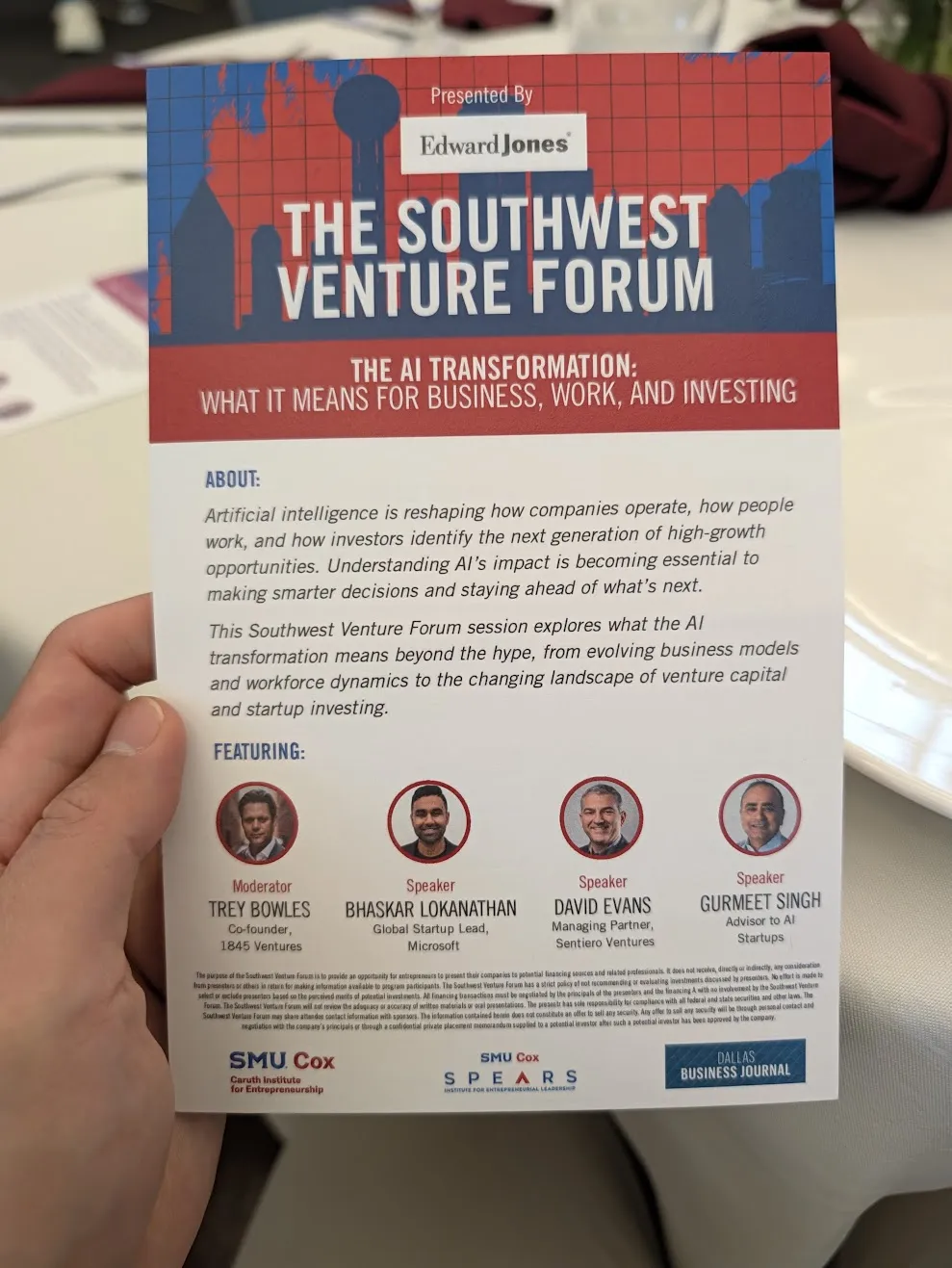
I serve on the advisory board of SMU’s Southwest Venture Forum, which gives entrepreneurs a chance to present to potential investors and gets the Dallas ecosystem in a room talking. This session was titled “The AI Transformation: What It Means for Business, Work, and Investing.” Edward Jones presented it, alongside SMU Cox’s Caruth Institute, the Spears Institute, and the Dallas Business Journal. Trey Bowles of 1845 Ventures moderated. I’ve seen Trey on a number of panels, and he’s always thoughtful and articulate in how he handles the people on stage, which is harder than it looks when everyone up there has strong opinions about AI.
Cheap Tools, Expensive Judgment
Bhaskar Lokanathan, who leads global startup development for Microsoft, started with product. To someone outside tech, “product” sounds like the thing you buy, but in software it means the decisions about what to build: who it’s for, what problem it solves, and what it feels like to use. The code is just how those decisions get carried out. Uber didn’t win on mapping or payments software, both of which already existed. It won because someone decided you should tap a button and a car shows up. There’s an art and craft to figuring out what a person actually needs, and Bhaskar’s view is that the craft beats raw technology. When AI can generate the code and the interface for almost anyone, that judgment is what’s left to compete on, so he expects product to be the big differentiator going forward. He paired that with a point that makes the craft harder, which is that the frontier labs are changing what AI can do on a monthly basis. A founder can’t build for the market as it is right now, because the market will have moved by the time the product ships, so my read is that a lot of the craft comes down to deciding what to build now and what to wait on.
Gurmeet Singh, who advises AI startups, took the same idea up to the executive suite. He argued that AI transformation starts with leadership, and that leaders need to fully understand the impact and the outcomes they want before anyone starts building. Otherwise companies end up with a graveyard of AI pilots… lots of experimentation and no idea of what success would look like. I think that’s the enterprise version of Bhaskar’s point. When it costs almost nothing to spin up a pilot, the pilots stop being the constraint, and the scarce thing becomes somebody senior who knows what the pilot is supposed to prove.
David Evans of Sentiero Ventures was working on AI before it was cool, and he’s a good friend and fellow lecturer at UTD, so I’ll admit some bias. His point was about what a startup anchors to. If you start from what today’s AI can do and build a product around it, you’ve built inside a box that the next model release will redraw. If you start from the customer’s problem, the tools become interchangeable, and you can swap them out as better ones arrive. He framed it as creator versus doer. A doer has a piece of software that does one thing and calls it a product, so every model upgrade is a threat. A creator is loyal to the problem rather than the software, so the same upgrade is just a better tool. A startup that sells invoice-scanning software has to hope nobody builds a better scanner. A startup that gets contractors paid faster doesn’t care which scanner it uses. Nobody has a playbook for this yet, the big companies included, so the advantage goes to whoever is willing to rebuild their own product every time the tools change.
The Unicorn Math
David also made a great point about market size. Because AI makes software so cheap to build, it now makes sense to build for very narrow use cases, like scheduling for veterinary clinics or compliance for regional banks. Those can be great businesses, but each market is small, and small markets rarely produce unicorns. So his advice to founders was to start without VC. Get customers, drive growth, and keep costs down, which is easier than ever when you don’t need millions to get an app off the ground. If the company turns out to be big, the traction you built is exactly what gets VCs excited anyway. In his words, VC is an accelerant, not a starting point, and very few businesses are built for VC-style outcomes.
Why so few? It comes down to how a venture fund gets paid. Say a fund raised $50 million and wants to return three times that to its investors (the numbers here are illustrative). That’s $150 million, and since most of its companies will return little or nothing, one or two winners have to carry the fund. If the fund owns 10% at exit, a winner has to sell for well over a billion dollars to matter. Now take one of David’s narrow-market companies. It does $20 million a year in a niche it dominates and sells for $100 million. The fund’s 10% is worth $10 million against a $150 million target. A founder who skipped venture and still owns 70% walks away with $70 million. The same exit changes the founder’s life and barely registers for the fund.
Why I’m Pausing
The pace of change is also why I’m currently pausing my AI-related investments. For a while now my first screen has been whether a frontier lab’s services arm makes a company more or less valuable. At Bhaskar’s monthly pace, I can’t answer that question with any confidence for longer than a quarter. That’s a problem when a check I write today will be held for seven to ten years, through something like a hundred model releases. Any diligence I do now has a shorter shelf life than the investment. I watched this happen when OpenAI’s integration with Epic wiped out a whole cohort of healthtech middleware in one announcement. None of those companies did anything wrong. Their product was an integration that the platform decided to do itself, which makes them doers in David’s terms.
Most funds can’t do what I’m doing. A fund with outside investors and a deployment clock has to put capital to work, so it has to make the call now even when the uncertainty is at its highest. I invest my own money and have no clock, so waiting costs me almost nothing. And every month I wait, the models settle a little more, and it gets clearer which companies are creators. When the bets are this hard to price and waiting is free, not betting is a position too. The creators are out there, and I’ll be watching for the ones who stay a step ahead every time the tools change.
If you’re a founder in Dallas and you haven’t been to a Southwest Venture Forum, come to the next one. You’ll meet interesting people, and you’ll probably leave with a few ideas you didn’t walk in with.