
Midterms
October 8, 2026 · James Wang
The AI tools college students have today are awesome, and whether any given student uses them is still up to the student. It’s midterm season in the Innovation and Entrepreneurship class I teach at UT Dallas, which for my undergraduates means an exam this afternoon and a round of pitches next week with me as the judge.
Back in August I wrote that my AI policy for this class is to use it, aggressively. I’m excited to try this model because of how much help a student can get now without me. It used to be that if something in a lecture didn’t click, a student could reread the textbook or wait until the next class to ask about it. Now any student can have a chapter explained five different ways at midnight, get quizzed on it, and have a deck critiqued before I ever see it. Every one of my students has access to all of it, which means the difference between two of them comes down to whether they bother to use it.
Everything Is on the Slide
A test usually measures a few things at once. It measures whether you know the material, and it also measures how well you guessed what the professor would ask and how much you could hold in your head for an hour. I only care about the first one, so I tried to take the other two away. For the guessing, I showed the class a slide with the share of questions coming from each topic.
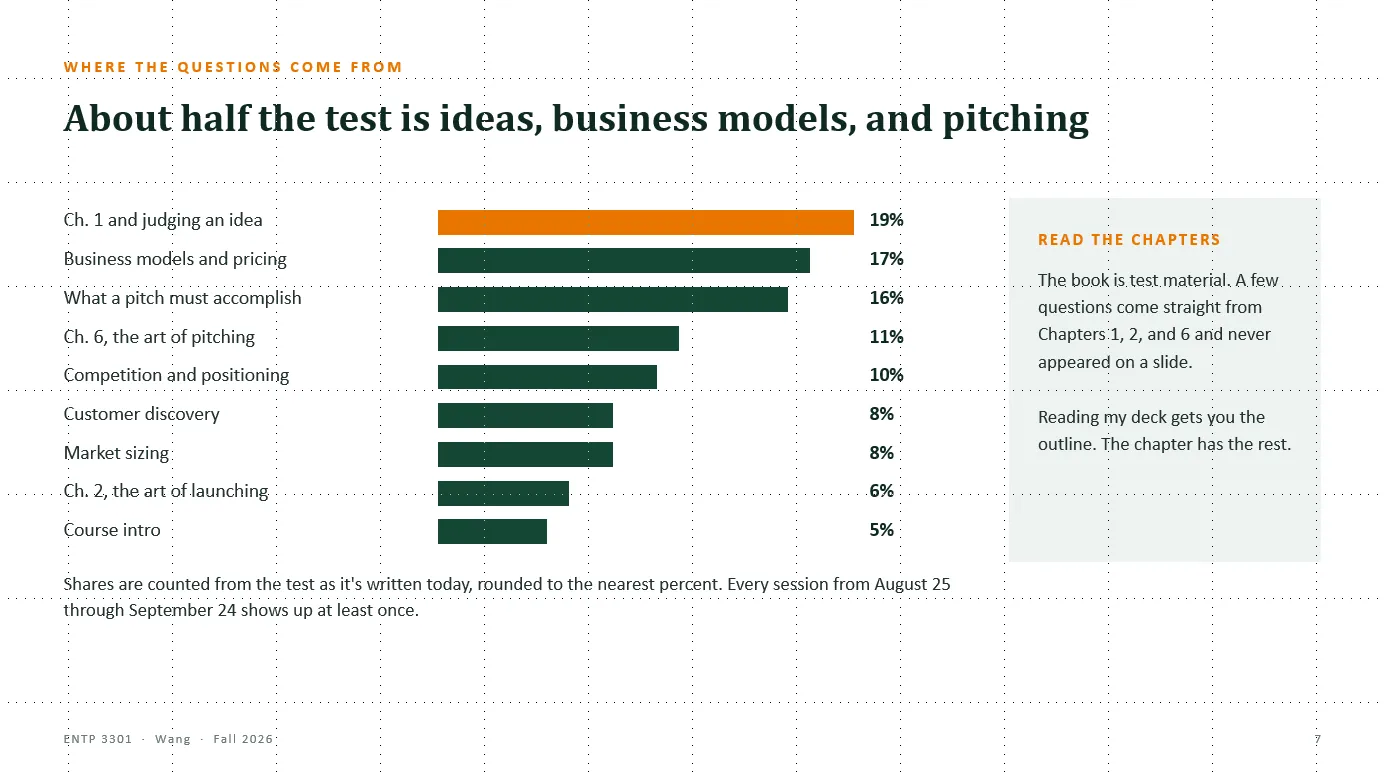
Read literally, the slide says about half the test is ideas, business models, and what a pitch has to accomplish, and that three of the nine rows are chapters of the book. The box on the right says a few questions come straight from Chapters 1, 2, and 6 and never appeared in my decks. That means studying my decks, or an AI summary of my decks, won’t cover everything on the test, and the students know that because I told them.
The same slide puts customer discovery at 8% of the test, and the test is 20% of the grade, so the topic I’d argue matters most in the whole course is worth 1.6 points out of 100 on paper. A student planning their study time off the slide would be right to give it almost nothing this week. I think that’s fine, because talking to customers is something a written test measures badly, and it’s one of the pieces I grade in the pitch, where it’s a lot harder to fake.
For the memory, I’m going kind of old school. Each student gets one 3x5 index card as a cheat sheet, handwritten only, front and back, and turned in with the exam. When I was in school, I felt like I learned more from making the cheat sheet than I did from straight up studying. A card that small forced me to condense the material and put it in context, because I had to decide what was important enough to earn the space, and rote memorization never asked me to do that. That’s why the card has to be handwritten.
Turned in means I get a stack of cards showing what my students thought was important, so I can adjust my lectures to match. That’s a lot of what I’m trying to do with this course in general. I’m doing the things I wished my professors had done, and I’m keeping the things my own professors did well. I told them the card was a gift, and I’d guess I get as much out of it as they do haha.
None of this makes the exam hard, and I don’t expect it to be. If a student goes over what I showed in class and reads the few chapters in the book, they should be fine. I have no interest in playing gotcha, because the goal is to get them to prepare and think for themselves, and with any luck to care about the material.
The Range
My biggest surprise so far has been how wide the range is in student quality and work ethic. Some students are really engaged and great, and others are barely in class, and I’m sure their grades will reflect that. I’ve clearly set out my expectations, and I constantly ask whether anything is unclear or confusing, because I try to give them as many opportunities to succeed as I can. I’ve told all of them that in my class if you show up and put in the effort you’ll do well. As they say, you can lead a horse to water, but you can’t make him drink.
To be fair, none of that is new, and this is my first semester teaching. I’m sure professors were surprised by the same range long before anyone had a chatbot, so I can’t claim AI made it wider. I do think AI took away an excuse. Help used to be limited to class time and whatever a student could get out of the book, and now it’s free at any hour, so more of the gap comes down to who shows up and does the work.
First Time I’ve Seen It
The pitches run on the same idea. I’ve told the class that I expect the slides themselves to be perfect, since there’s no excuse anymore for a spelling or formatting error. I’ve also told them exactly what I’m grading, which is problem, solution, value proposition, competition, business model, and customer discovery. So the deck is the part the tools can carry, the rubric is public, and what’s left is a student standing in front of the room answering questions.
The Q&A should be the most fun. I’m going to pretend it’s my first time seeing every one of these presentations, which is how anyone outside the classroom would see them. I’m looking forward to ripping into them… granted, these are undergraduates, and I’ll only comment on the pieces I’ve explicitly said I’d grade. A hard question you were told to expect is fair, and I think it’s the kind that teaches the most.
Show up, put in the effort, and you’ll do well is a deal that no market offers a founder, and I’m offering it in a class about becoming one. Plenty of founders do the work and still lose to timing or to a competitor with more money. I think the fair version is right for a first course, because a student has to care about the material before the unfair version is worth teaching.
I don’t have a single grade yet, so for now all of this is a design and a guess. What I’ll be watching is whether the scores line up with who has been in the room, and what my students chose to write on an index card. I think the point of teaching is to make sure they absorb something, and to do it in a way that’s interesting enough that they want to. The cards come back to me this afternoon, and I guess I’ll find out which parts of the last six weeks made it onto them.