
RAPID and the FDA Device Pathway Maze
June 23, 2026 · James Wang
Last month the FDA and CMS proposed something that, if you build or fund medical devices, is worth ten minutes of your attention. It’s called RAPID, and the short version is that the government is trying to close the gap between the day the FDA lets you sell a device and the day Medicare actually agrees to pay for it. That gap can run for years.
More on RAPID in a minute, because to see why it matters you have to see the map it’s redrawing, and most people outside healthcare have never seen the map.
First, scope. This is the device side of the FDA, a different center than the one that handles drugs, and it works nothing like the drug-approval process people picture when they hear “FDA approval.” It also covers diagnostics and lab tests, which are regulated as devices and run the same routes. So everything below applies to a blood-pressure cuff, a surgical robot, and a cancer screening test, but not to a pill.
There are three doors to the US market, plus a fast lane, and the one you walk through shapes the business as much as the device does.
The Three Doors
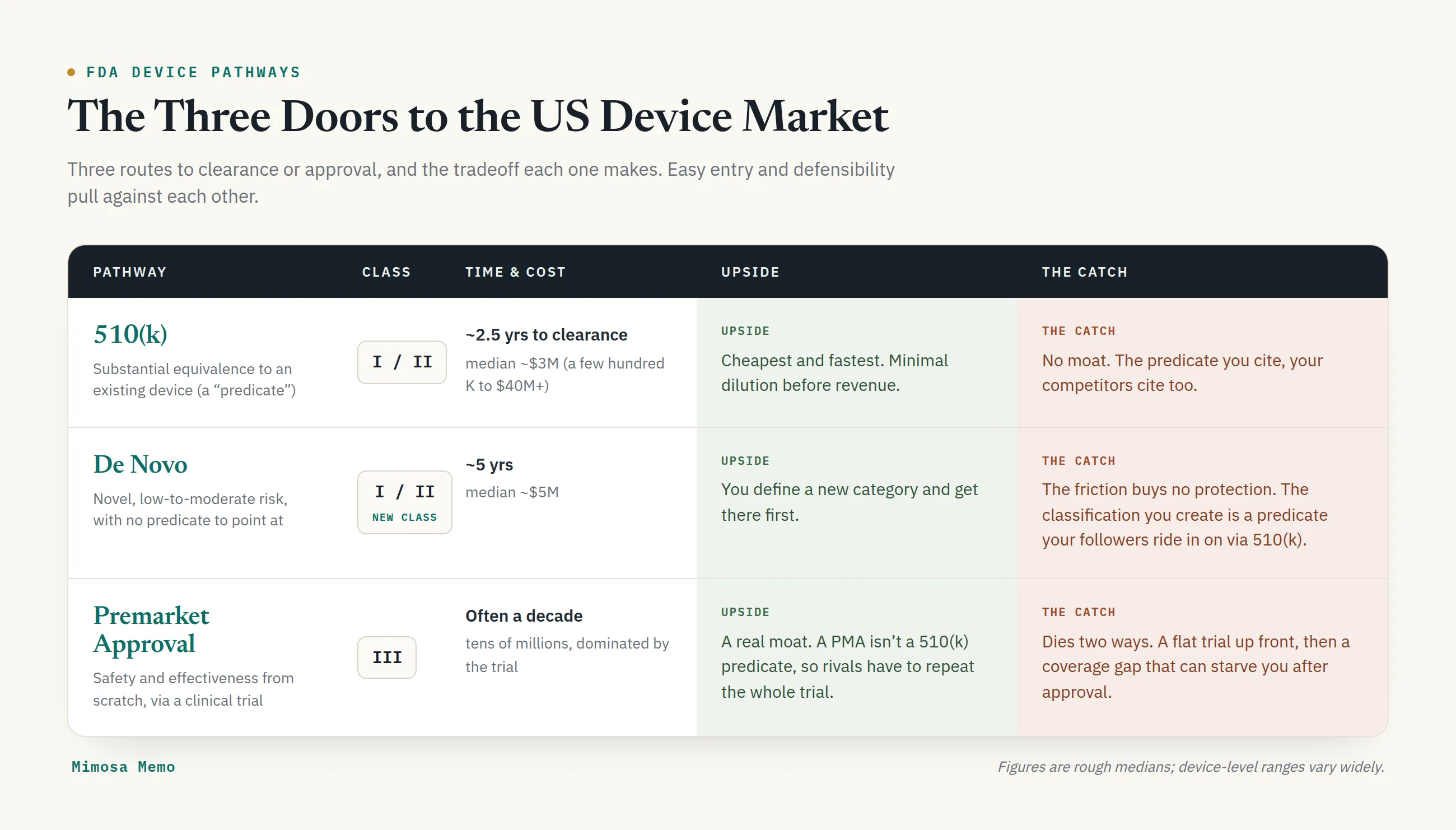
A vocabulary note, because the people you pitch will care: 510(k) devices get cleared, PMA devices get approved. Different words, different legal weight.
The pattern in that table is the whole game, with one exception worth sitting on. Ease of entry trades against defensibility. The cheap 510(k) door is the crowded one, which is why so many of those companies top out as modest acquisitions rather than venture-scale outcomes. There’s nothing structurally scarce about what they built. PMA is the opposite. It’s expensive because the expense is the barrier, and a PMA device can’t serve as a 510(k) predicate, so the friction you survive is friction your competitors have to survive too. The cost compounds into a moat.
De Novo is where that logic breaks, and the table flatters it. It carries real friction, roughly twice the time and money of a 510(k) plus genuine novel work, and none of it converts to protection. The classification you create is a predicate, so your fast-followers walk in through the cheap door you just built for them. You pave the road and watch everyone drive on it for free. On a risk-adjusted basis it’s the worst of the three, unless your moat comes from somewhere regulation doesn’t reach, like brand, data, or distribution. De Novo is sometimes unavoidable, since a truly novel device has no predicate to cite. Just don’t mistake the hard work for a wall.
Cleared, Approved, Covered
Those are three different words, and only the third one pays you.
Clearance or approval means the FDA agrees you can sell. Coverage means a payer agrees to actually hand over money when you do. The bridge between them is your label claim, which is the entire commercial engine. A weak claim is a weak reason for a clinician to switch and a weak case for an insurer to reimburse.
Here’s the trap the cheap door sets. A 510(k) inherits the predicate’s intended use, so you can’t claim your device does more than the predicate already claims without generating clinical data. The moment you generate that data, you’ve rebuilt the expensive path you were trying to skip. And the evidence that earns you a strong claim is the same evidence payers want before they’ll cover you. Skip it to move fast and you arrive cleared, claim-constrained, and unpaid.
This is not a rounding error. The device industry’s trade group likes to cite a median gap of nearly six years between FDA authorization and Medicare coverage, though that number is skewed upward by all the novel devices that never clear national coverage at all. CMS’s own baseline is closer to a year or more. Either way, plenty of cleared devices sit on the market and unpaid long enough to run out of money.
What RAPID Is Trying To Fix
That coverage gap is what RAPID goes after. The name unpacks to the Regulatory Alignment for Predictable and Immediate Device coverage pathway, and CMS and FDA announced it jointly. The stated purpose is to expedite access to certain FDA-designated Class II and Class III Breakthrough Devices for people on Medicare. The mechanism matters more than the press release. The idea is to stop running FDA review and Medicare coverage back to back and start running them together. A device in the program would get a proposed Medicare coverage decision the same day it receives FDA authorization, with coverage possible in roughly two months instead of a year or more.
The pitch is forward design. You let CMS into the room before you design your pivotal trial, so one evidence set clears both agencies, and the reimbursement bar moves to the front instead of ambushing you after launch.
Two things keep it honest. It’s still a proposal in a comment window, open to a narrow set of Breakthrough-designated devices, and it doesn’t guarantee payment so much as synchronize the timing, with CMS still holding the final say. The deeper catch is that the mechanism it sells is the one you can’t safely use. Forward design means betting your trial on the program still existing in five years, and this is the third version of this idea in five years. An automatic-coverage rule was finalized in 2021 and scrapped before it took effect; its replacement was finalized in 2024 and just got paused. The only safe way to plan around RAPID is to build a company that’s fine if RAPID dies, which means it shouldn’t shape your trial at all. What’s left is the retrospective version, a timing accelerator that pulls cash forward for companies already on the PMA path and already committed. Helpful, not something you build on.
The Claim Picks the Door
Getting cleared was only ever the first step. Getting paid is the real goal, and which fight you’re signing up for is set earlier than most founders think, at the moment you decide how ambitious a claim to make.
You don’t really choose a pathway. You choose how bold a claim to put on the label, and the device class falls out of that. The same hardware can be a cheap, predicate-able 510(k) or a multi-year trial, depending on how you write the intended use. Take AI diagnostics. Framed as clinician-confirmed decision support, with a doctor reading every result, the model is a cheap clearance. Framed as an autonomous diagnostic that calls it without a doctor, it has no predicate and eats a De Novo or a full trial.
That scoping decision usually gets narrated as product focus. More often it’s a budget. A founder staring at a decade and tens of millions for the ambitious claim writes the narrow one instead, because the narrow claim is the financeable claim. It’s the cheap door one level up. And the modest claim is a great way to get to market, perhaps setting the foundation for more claims in the future, but go into it with your eyes wide open, because the thin claim that clears easily is the same thin claim no payer wants to cover.