Dallas Is Early
June 2, 2026 · James Wang
Two weeks ago I wrote that Dallas cracking Carta’s top 10 was the floor, not the ceiling, and that climbing the chart would take three things the ranking couldn’t show me… repeatable institutional infrastructure, deeper local capital, and exits that recycle returns back into the system. Call it a three-legged stool, and all three legs still have to be built by hand. Then I spent the next two weeks in rooms full of people building the first one. It’s going up fastest, and that’s worth noting, because it’s racing to keep pace with the one thing nobody had to build at all… the founders, who showed up on their own.
The Eyes Are On Dallas
There are more founders in Dallas than there have ever been, and more people outside Dallas paying attention to them.
I sit on the Richardson Innovation Advisory Committee, which Amir Omar, the mayor, runs a couple of times a year. This round the agenda was how to get startups to build in Richardson and why it’s already a good place to do it. Plenty of economic development offices around here have chased startups for years, so a city wanting them isn’t the news. What’s new is that there’s finally a real enough founder base to compete over, and Richardson is treating it seriously. A lot of that base traces back to UT Dallas, which sits right there and is unapologetically a STEM school, quietly feeding engineers and technical founders into the ecosystem for years. The city’s bet is the Innovation Quarter, the 1,200 acres that used to be the Telecom Corridor, back when Nortel and Ericsson and a wall of telecom names made it one of the densest tech strips in the country. The dot-com bust hollowed it out. Richardson rebranded it in 2019 and has been trying to rebuild it as a startup district ever since, with a headquarters it runs jointly with UTD. The bones are real. Whether the second act lands is still being written.
David Evans at Sentiero Ventures put together a mixer to get Dallas and Austin VCs in the same room at Old Parkland. The conversation kept landing on a hard question: how do we find and fund more of these Dallas-native companies ourselves, before the coasts do? Most of the outside money that lands here arrives through a relationship the founder already had, which makes sense, that’s how venture works. But it means the early local checks get written somewhere else simply because somewhere else saw the deal first. Closing that gap takes a tighter-knit ecosystem that surfaces these companies early.
Then there was the Scientifica Sessions event, hosted at the Health Wildcatters HQ in Pegasus Park. Tabari Baker is taking that podcast across the country, profiling one innovation ecosystem at a time, and Dallas was a standout stop on the map. Eric Moore at BioNTX, which sits near the center of the North Texas life sciences scene, pulled together a great crew for the Dallas episode. I sat on the panel with people from across the ecosystem, the Dallas Regional Chamber and Dallas College among them, and the whole conversation was about why Dallas specifically. That’s a question with a much longer answer than it would have had a few years ago, and our taping ran almost two hours. Worth a listen when it drops.
So that’s a lot of eyes on one metro… a city government, a room of VCs, a national podcast. But eyes aren’t founders. To find the founders I just had to look at the rooms where I spent the rest of my time speaking.
The Tell Is in the Curriculum
Most of what I did was teach. A MassChallenge customer discovery panel run by Aman Sohail, with Katie Cashman Rogers from JPMorgan and Carson Gibbons, the founder of DallasMeetup and a YC alum. An hour-long talk at the inaugural Secret Startup Series, which Bhavna Kumar of the SMU Spears Accelerator built to teach DFW founders how to raise. The founders packed those rooms, in volume and in variety. The supply side isn’t really the question anymore.
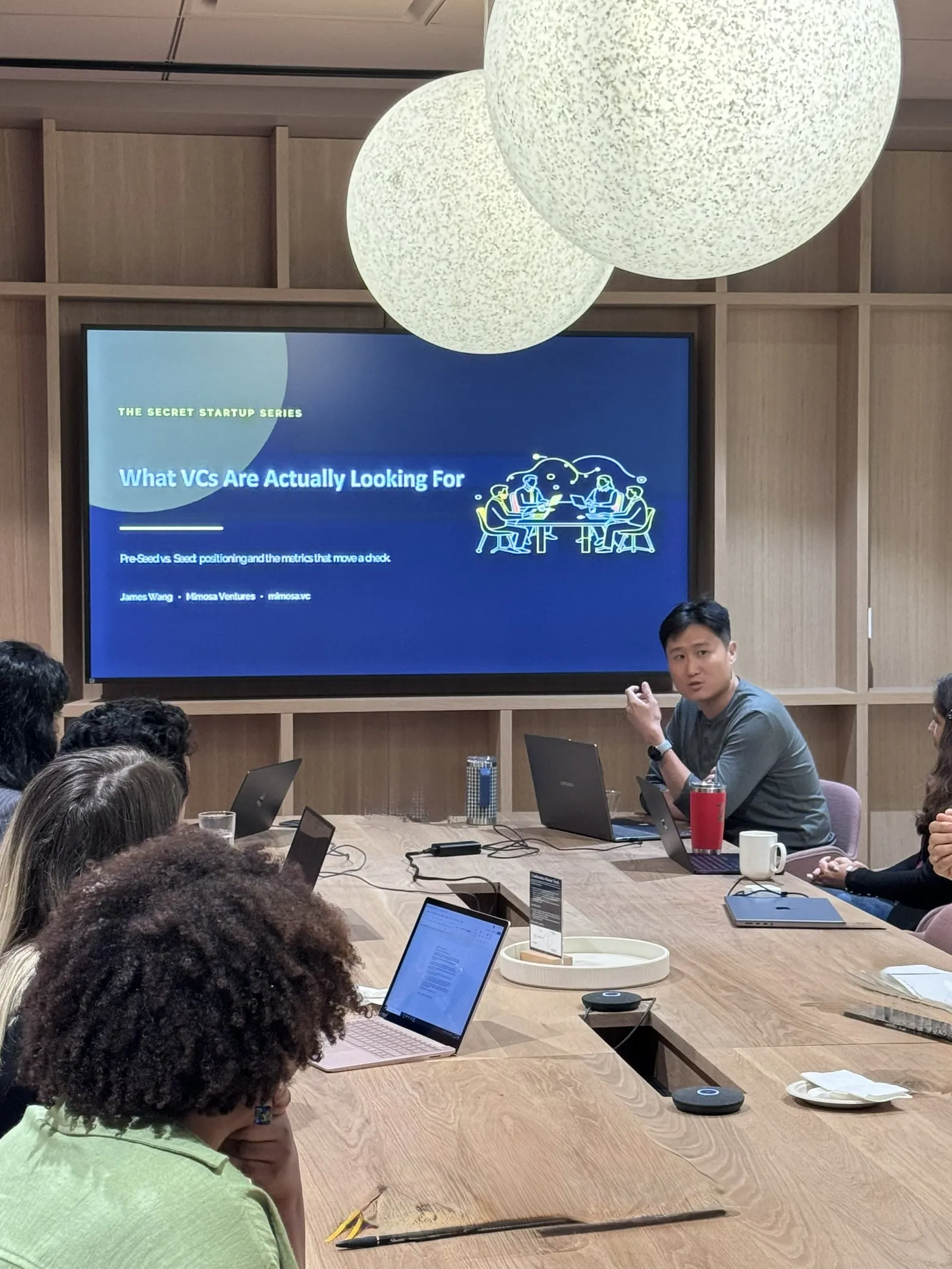
You run “what do VCs look for” and “how to actually do customer discovery” sessions when you’ve got a wave of founders who haven’t done either before. Mature ecosystems need them less, because the knowledge is already in the water. The existence of those rooms tells you a market is forming.
It also tells you something a lot less flattering, and the frustrating part is that it’s the same fact. If the founder base is green enough that raising and customer discovery have to be taught on purpose, then the median deal coming out of it is raw. Not all of it… there’s a fundable top in any cohort. But that fundable layer is thin relative to the noise, and a sophisticated lead knows it. Which is exactly why that lead underwrites Dallas deal by deal from a desk in California or New York instead of committing to the metro and opening an office. Cherry-picking remotely is the rational response to a thin fundable layer sitting on a green base.
Founders forming and capital commuting aren’t two separate signals. They’re one. The first causes the second. The capital commutes precisely because the curriculum is still necessary
The Part That Comes Free
This is where the optimism gets slippery, because founder supply is the one part of this that mostly builds itself.
Founders respond to opportunity. Lower the cost of living, relocate a few thousand bank and tech jobs, stand up some accelerators, and people start companies. You don’t have to engineer it so much as avoid getting in its way. That’s the part I watched show up, and it really is showing up.
The legs don’t come for free. The two hard ones, deeper local capital and exits that recycle, have to be built against gravity. The worry isn’t that companies leave. A Dallas company can raise from a coastal fund, keep every employee and the headquarters right here, and operate in this metro for its entire life. The check coming from California doesn’t put anyone on a plane.
The leak happens at the exit. When that company sells, the bulk of the return flows to the fund that led it, and that fund redeploys it into its next fund, raised from its LPs, spinning the flywheel where the capital came from. The institutional upside, the part that compounds into the next generation of funds, recycles on the coast.
But the founder and the early employees get rich too, and they tend to stay. The easy move is to wave that off as a rounding error next to the fund’s haul. By dollar volume, sure. By impact, it might be the whole game. Silicon Valley wasn’t seeded by Sequoia’s LPs recycling their returns. It was seeded by the PayPal crew, founders and operators who got liquid and turned around to start Tesla, LinkedIn, and YouTube, and to write the first checks into a hundred other things. Operator wealth that stays in the room is how an ecosystem bootstraps its own next generation.
So the bar isn’t deeper local capital in the abstract. It’s whether Dallas produces enough big exits that the founders and operators who win them stay and reinvest. The founder formation I just watched pack those rooms is exactly what feeds it. Without the exits, there’s no operator wealth to recycle and the engine never turns over. It all comes down to whether they show up.
The Assumption Doing the Work
I’d take that operator route over the alternative. The alternative is the one most of the Dallas-is-rising story quietly runs on, even if nobody says it outright. It assumes the local capital that’s missing eventually shows up on its own… that the family-office, energy, and real-estate money is just early, and will start behaving the way Boston money behaves once the ecosystem matures enough to deserve it.
Maybe. Or maybe that money is patient because patience is the correct move for it.
Texas capital has genuinely good alternatives. Energy, real estate, and public markets are well-understood, and venture as an asset class underperforms for most allocators most of the time. There’s also the mandate to consider. A lot of this is old family-office money, and family offices are built to preserve wealth, not chase it. Match the S&P year after year and that’s a win. Make a concentrated bet on a seed portfolio and lose it, and that’s a generational hole you dug yourself. The asymmetry runs the wrong way for venture, so the rational move is to never write the check. “Local money will start writing seed checks” quietly assumes venture earns its way into a portfolio that already has better risk-adjusted options sitting right there, held by people whose job is to not lose it. That’s not a trend I can point to, it’s a hope. The old money might never convert, and not because the ecosystem failed, but because the people holding it ran the math and the math said no.
Scaffolding Isn’t the Building
A few weeks ago, in The Win Condition, I worried the celebration in this ecosystem was running ahead of the substance. This stretch didn’t settle that argument so much as sharpen it.
The founders are here, in force, and that’s the part you can’t fake or manufacture on a whiteboard. But that’s the part that builds itself. The hard part is capital, and not because Texas is short on money. There’s plenty of it. It just doesn’t flow to early-stage venture, never has, and the old Highland Park money has better-understood places to put a dollar than a seed check. Maybe that never changes.
It doesn’t have to. The capital that closes the gap doesn’t need to be the old money. It can be new money, the kind that gets minted when a Dallas company exits big and its winners stay and start writing checks. And the more founders there are, the better the odds that happens. Venture runs on a power law… most attempts go nowhere, but enough swings means some eventually connect, and one outsized exit seeds a lot of angels. Volume is the whole point. That’s the version I’d bet on, because it’s the one founder formation is already building toward.
In the Top 10 memo I wrote that the ceiling is whatever we’re willing to build under it. Now I’d put it a little differently. The scaffolding is going up fast, faster than I expected. Scaffolding isn’t the building. The building gets built the day Dallas starts keeping the wealth it creates. The founders are here. The infrastructure and the community around them are rising fast. Now we need the exits.