The Calculator Question
May 5, 2026 · James Wang
AI isn’t eliminating jobs. It’s eliminating the jobs that used to make people good at their jobs. Most of the conversation about AI and the labor market is missing this, because the damage shows up in hiring data, not unemployment data, and on a delay long enough that nobody connects the dots.
The senior analyst who can direct agentic workflows and evaluate the output is now doing what used to require a team. The math on hiring three juniors gets harder every quarter. Not because anyone made a decision to stop hiring them, just because the spreadsheet keeps coming out the same way. Senior plus AI beats senior plus three juniors on cost, on speed, and increasingly on quality. Every individual call is rational. The aggregate is a slow-motion structural problem.
The Pipeline Problem
Judgment is built through apprenticeship. That’s been true forever. You sit next to someone who knows what they’re doing, you make a thousand small mistakes, you get corrected on the ones that matter, and a few years later you have intuition about things you couldn’t articulate. The first job is where that happens. The shitty modeling work, the late-night decks, the cleanup tasks that taught you what good looked like by contrast.
That first job is the one being optimized away. Not by malice, just by leverage. And the seniors are fine. The mid-levels are fine. There’s just nobody coming up behind them. By the time it shows up in unemployment data or talent shortages, the pipeline has been broken for half a decade.
The quarterly numbers look great. The org chart five years from now does not.
The incentive structure makes this worse. Training juniors has always been a public good. The company that does it eats the cost; the next employer captures the value. Always been an awkward equilibrium, but AI tilts the math hard enough that the equilibrium might not hold.
The Calculator Question
This is where the optimists usually show up. Every generation’s tools look like cheating to the previous one. Calculators were going to make kids innumerate. Wikipedia was going to destroy research. Google was going to rot memory. The hand-wringing was loud each time, and none of it was completely wrong… kids today probably can’t do long division as fast as their grandparents could. But the underlying skill shifted. We stopped needing the thing that got automated, and started needing something one layer up.
It’s a comforting story and I’ve told it myself. I think it’s also wrong, or at least not load-bearing the way people want it to be.
Calculators automated arithmetic. Arithmetic is a closed system. The rules are fixed, the answers are verifiable, and what gets built on top is a clean abstraction layer. You stop doing long division by hand because you don’t need to anymore, and the cognitive headroom you free up gets spent on algebra, modeling, statistics. The foundation is unchanged.
Judgment is not a closed system. It’s the open-ended skill of knowing what’s important, what’s missing, what’s wrong, what to do next when the rules don’t quite apply. AI is the first tool that automates the formation of judgment itself. We have no historical reference class for that. None. The calculator analogy works for closed-system skills and breaks for open-system ones, and anyone telling you they know how this plays out is bluffing.
The honest answer is that both the doom case and the it’ll-be-fine case are doing the same thing. They’re pattern-matching to a precedent that doesn’t apply, then performing certainty about which way the new thing breaks. The kids “cheating” with ChatGPT might be developing a more sophisticated form of judgment earlier than we did. Or they might be outsourcing the foundation that judgment is built on. Both are plausible. Neither has a clean precedent.
What You Do When You Don’t Know
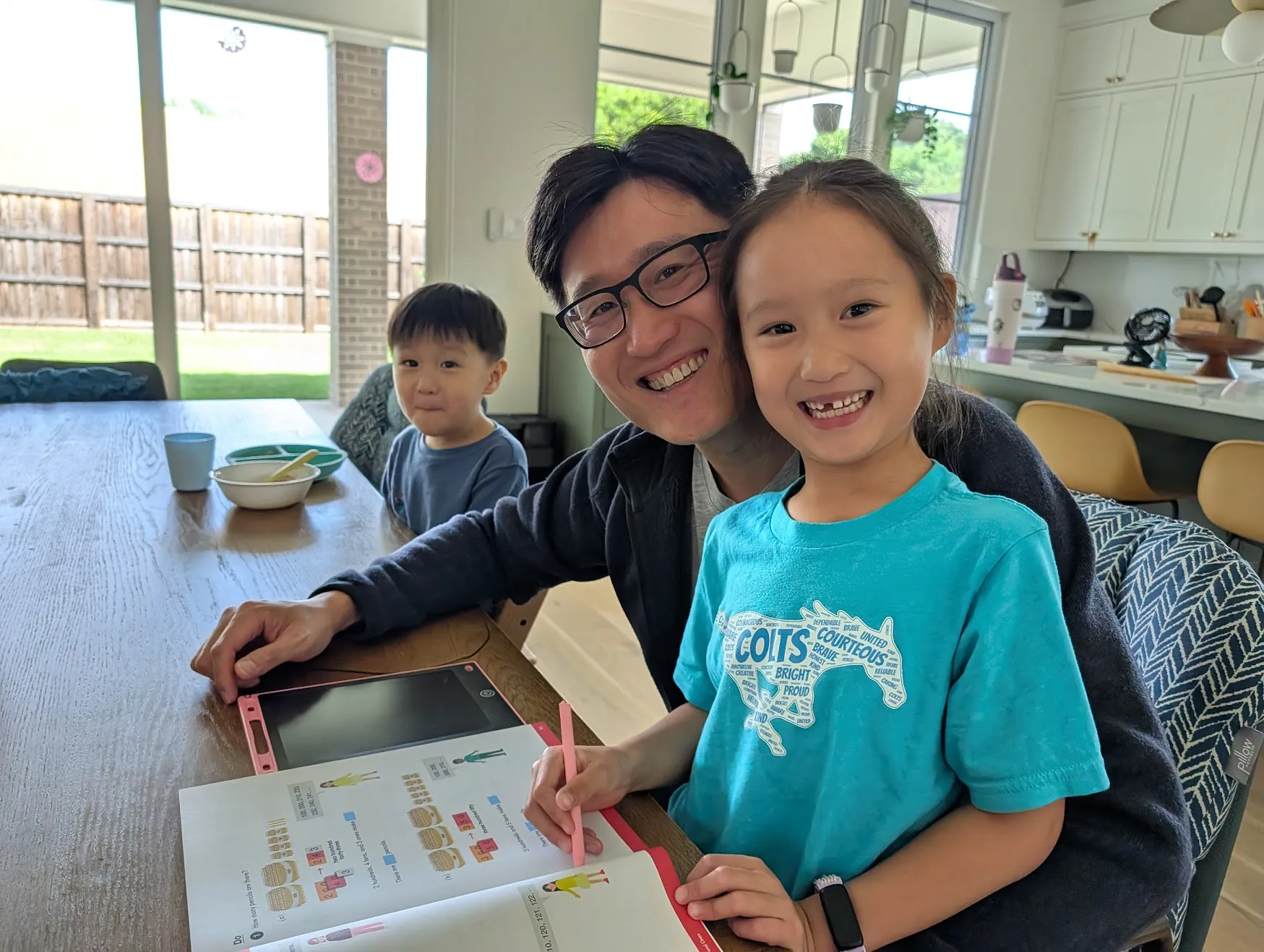
This is where I sit with my six-year-old daughter Samantha at the kitchen table almost every day, working through Singaporean math textbooks together. Not because I’m Asian and contractually obligated to be a tiger dad, although the stereotype writes itself. The deeper reason is that I genuinely don’t know which specific skills are going to matter for her in fifteen years. Nobody does. I learned to navigate the early internet by messing around on AIM (that’s AOL Instant Messenger for you kids out there) and forums and absorbed information triage as a side effect, but nobody taught me to. The skills that mattered for me at twenty-two are not going to be the skills that matter for Sammie, and any prediction I make about what they will be is going to look stupid in a decade.
So I’m not betting on a specific skill. I’m betting on the foundation. Logic, the patience to sit with a problem, the instinct that something is off before she can say why. Those are the things that don’t depend on knowing what AI looks like in 2040. They’re the floor. When I was a kid, having the fundamentals locked down gave me confidence, and that confidence is what let me branch out into things I wasn’t already good at, because the floor felt solid. I want her to have that same floor.
This isn’t optimism or pessimism about AI. It’s the only rational move under genuine uncertainty. If the optimistic case wins and AI-native judgment turns out to be a real and learnable thing, foundational logic is what lets you evaluate the machine instead of being captured by it. If the pessimistic case wins and a generation gets brittle from outsourcing too much, foundational logic is what makes you not brittle. The foundation is load-bearing under both futures. The specific skills people are arguing about are not.
When it’s your own kid, you don’t get to be detached about it. You also don’t get to pretend you can predict the future. You just bet on the things that pay off in every world you can imagine.
The Honest Position
The pipeline question won’t get answered by economists or by venture investors writing memos about it. It’ll get answered by whoever is six right now, doing math problems at the kitchen table, and showing up to their first job in fifteen years with a relationship to these tools that none of us can really imagine.
What I’m pretty sure of is that the people performing certainty about how this plays out are wrong, in both directions. The optimists are pattern-matching to a precedent that doesn’t apply. The pessimists are doing the same thing with a darker filter. The honest answer is that we’re running an experiment with no control group on the open-system skill that everything else gets built on, and we’ll find out what happens by living through it.
In the meantime, you bet on the foundation. That’s the only move that doesn’t require knowing things you can’t know.